
Search isn't just Google anymore.
Search used to mean Google. It still does, but it doesn’t stop there anymore. People are finding businesses through AI overviews, asking ChatGPT for recommendations, using voice assistants, and trusting answer engines to surface the best result without clicking through ten links.
SEO and AEO are closely related but distinct. SEO is about earning visibility in traditional search. AEO is about being the answer that AI platforms and voice assistants surface when someone asks a question. Both come down to the same core principle: give platforms the right trust signals and give users genuinely useful, accurate information.
We build strategies that do both.
A home care agency ranking on page four for their primary search terms. Within six months of a full technical and content overhaul, they held the top three positions for core keywords — and started appearing in AI overviews for relevant queries.
Technical health, content gaps, competitor analysis, and keyword landscape.
We go deep on high-impact pages first — not a handful per month.
Structured data implementation for AI and voice visibility.
Directory submissions baseline + optional aggressive backlinking.
Real metrics, honest context, monthly reviews with clear data.
We front-load the work. A lot of agencies optimize a handful of pages per month and call it progress. We go deep from the start — identifying the pages that will have the most impact and optimizing them right away. Faster results, earlier data, smarter decisions.
We think about it simply: SEO builds it, schema labels it, and backlinks validate it.
We create and optimize content around what your customers are genuinely searching for — the questions they're asking Google, the prompts they're typing into ChatGPT, the things they want a straight answer to.
Title tags, meta descriptions, internal linking, keyword placement — the technical and editorial work that tells search engines what your pages are about and why they should rank.
Monthly directory submissions as a baseline. For businesses that want to move faster, we offer a more aggressive strategy — reaching out to high domain authority sites to earn links that meaningfully strengthen your site.
Especially important for AEO. Structured data helps search engines and AI platforms understand your content clearly enough to surface it as an answer, not just a result. For niche, high-intent businesses, this is a real competitive advantage.
Real metrics. Honest context.
We report on real metrics — not rankings for keywords nobody searches. Not graphs that look impressive because we chose the right starting point. Actual visibility, actual traffic, actual movement.
SEO takes time. Anyone who tells you otherwise is selling something. What we can promise is that you’ll always know exactly what’s happening, why it’s happening, and what we’re doing about it. If something isn’t working, we’ll tell you before you have to ask.
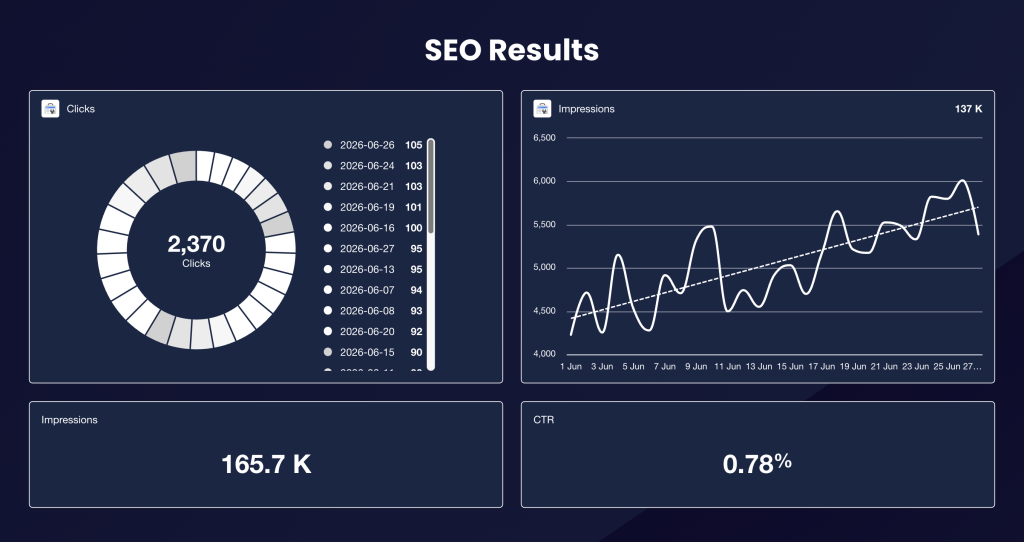
We don’t hide behind complicated dashboards. This is a real example of how we present performance data to clients — clear, in plain English, with honest context.
Ready to see where you stand?
Start with our free marketing audit. We’ll look at your current search visibility, identify the biggest gaps, and give you an honest picture of what it would take to improve. No pitch, no pressure.
Tell us about your business. We’ll look at what’s working, what isn’t, and where there’s room to grow — no pressure, just clarity.
Or text us — we actually respond.
SEO / AEO Questions
Longer than most agencies will admit. You can start seeing movement in three to six months, but meaningful, sustainable results typically take six to twelve months depending on how competitive your market is and how much work the site needs upfront. We’ll give you an honest timeline before we start and show you real data along the way so you always know where things stand.
SEO is about earning visibility in traditional search results on Google and other search engines. AEO is about being the answer that AI platforms and voice assistants surface when someone asks a conversational question. They’re closely related and built on the same core principles, but they require different content strategies and technical setups. We build for both.
Because faster optimization means faster data. When we optimize a handful of pages per month, it takes much longer to understand what’s working and what needs to change. We go deep from the start so we can start learning and adjusting sooner, which leads to better results in less time.
A backlink is a link from another website to yours. Search engines treat backlinks as votes of confidence. The more high-quality sites that link to you, the more authority your site builds, and the better it tends to rank. Not all backlinks are equal though. A link from a respected, high-traffic site is worth far more than a link from a low-quality directory.
Structured data is code added to your website that helps search engines and AI platforms understand exactly what your content is about. It’s what enables rich results in Google and makes it more likely that AI tools surface your business as a direct answer to a relevant question. For most businesses we work with, yes, it’s worth doing.
Yes, and anyone who tells you otherwise isn’t being straight with you. Search rankings move based on algorithm updates, competitor activity, seasonality, and dozens of other factors. What matters is the overall trend over time, not any single month. We report on real visibility and give you honest context when numbers move in either direction.
No. Any agency that guarantees specific rankings is making a promise they can’t keep because no one controls Google’s algorithm. What we can promise is that we’ll do the work correctly, report on what’s actually happening, and adjust strategy based on real data.
They complement each other well. Paid ads give you immediate visibility while SEO builds over time. A site with strong SEO also tends to have better quality scores in Google Ads, which can lower your cost per click. The biggest advantage of SEO over ads is that organic traffic doesn’t stop the moment you pause your budget.